.png)
Summarize this article with:
Cloudflare Workers AI is the best free option for speed, Leonardo AI API is the strongest choice for quality-focused workflows, and Pollinations.ai is the simplest option when no API key required is the priority.
A free AI image generation API is a hosted service that accepts a text prompt or reference image and returns a generated or edited image through an HTTP request. Most free plans include limited credits, daily compute quotas, rate limits, or trial access rather than unlimited production usage.
Developers who need more control can instead deploy open-source models on their own GPUs, but this adds infrastructure, VRAM, and maintenance requirements. This guide compares hosted APIs, self-hosted open-source models, and image-generating LLMs.
What is the difference among Image Generation API, Open-source Model and LLM ?
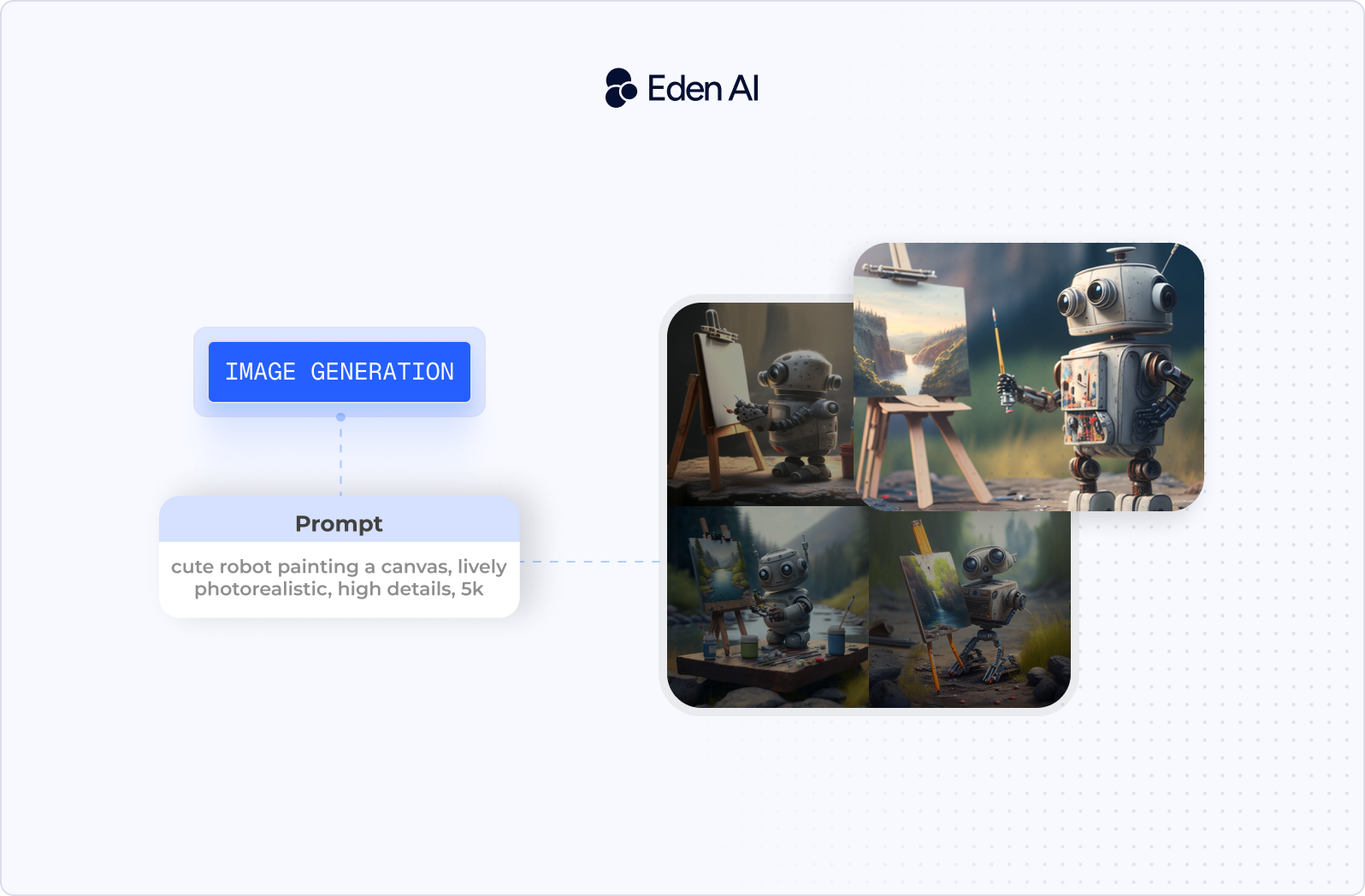
A free image generation API is a hosted service that allows developers to generate, edit, or transform images by sending requests to an external provider. An image generation API is best for teams that want to add image generation quickly, test a free image generator API, or build production-ready features without hosting models themselves.
An open-source image generation model is a model whose weights or source code are publicly available, allowing developers to run, fine-tune, or deploy it on their own infrastructure. It is best for teams that need self-hosting, more customization, or lower costs at scale.
An image generation LLM is a multimodal large language model that can understand text and sometimes images while also generating images as part of a broader conversational workflow. It is best for assistants, copilots, and multimodal products where image generation is only one part of the overall user experience.
Below we give you a short comparison table about the difference among an image generation API, an open-source generation model and an image generation LLM, including their quality, control, ease of use, multi-modal workflow and cost efficiency.
Free AI Image Generation APIs With No Key Required
In practice, “no key required” usually means a public demo, not an API intended for application development. The closest alternatives are APIs with instant free keys and no credit card, browser sandboxes, and community-hosted demos with limited availability.
For production use, create a free API key so you have authentication, documented quotas, predictable endpoints, and basic usage controls.
Best Free Image Generation API in 2026
Cloudflare Workers AI is the best free image generation API for fast prototypes and edge deployments, while Replicate is the better choice for testing a broad model catalog. Google Gemini API is the strongest option for products that combine image generation, editing, and chat in one multimodal workflow.
Cloudflare Workers AI
Cloudflare Workers AI is one of the best free image generation APIs for teams that want fast testing, simple deployment, and edge-native infrastructure. Its biggest advantage is not just the image generation API itself, but the fact that it is built into the broader Cloudflare ecosystem, including Workers, R2, and Images.
Pros:
- free daily allowance
- fast and easy to test
- simple to connect to an existing Cloudflare setup
- convenient for small apps, prototypes, and edge-based workflows
Cons:
- smaller catalog than some image-specialized API providers
- image generation quality can be less consistent than dedicated image platforms
Best For: Teams that already use Cloudflare, want to launch an MVP quickly, and need inference plus infrastructure in one place rather than the broadest possible image model selection.
Free tier: Up to 10,000 Neurons per day.
Pricing: Then $0.011 per 1,000 neurons above 10,000 Neurons free.
Replicate
Replicate is one of the most flexible free image generation API options for developers who want to compare models, test workflows, and switch providers without rebuilding their stack. Replicate’s main strength is breadth: it gives developers access to open-source and proprietary image generation models through one consistent API layer, making it a strong choice for experimentation and fast product iteration.
Pros:
- easy to use
- excellent for MVPs and testing
Cons: not always the most cost-effective option at scale.
Best For: Teams that want a free image generation API for experimentation, need access to many models, and want to compare price, speed, and quality before choosing a long-term solution.
Free tier: No guaranteed recurring free API allowance; selected models may be tested before billing, but API requests require a token.
Pricing: Pay-as-you-go. FLUX 1.1 Pro starts at $0.04 per image, Recraft v3 at $0.04 per image, and Ideogram v3 Quality at $0.09 per image.
ByteDance Seedream
ByteDance Seedream is a strong free AI image generation API for teams that care most about prompt adherence, image editing, and reference consistency. Its key differentiator is that it combines generation and editing in one model family, with a strong focus on preserving subject details and handling controlled, reference-based workflows.
Pros:
- strong prompt following
- good realism
- useful for reference-image consistency
- better suited than many rivals for controlled image editing workflows
Cons: version differences can create inconsistency
Best For: Teams that need strong reference-based editing, product visuals, controlled creative iterations, or character consistency, and want a cost-competitive image generation API without needing a broader multimodal platform.
Pricing: Free trial quotas range from 50 to 200 images. Paid pricing starts at $0.045–$0.075/image for Seedream 5.0 Pro (tiered by resolution) and 5.0 Lite is ~$0.035/image.
Leonardo AI API
Leonardo AI API is one of the best free image generation APIs for teams that want creative control, production-ready visuals, and more than a basic image generation endpoint.
Leonardo AI API is designed for creative production workflows, with features built for PhotoReal generation, image guidance, styles, model recipes, and a smoother path from testing outputs in the app to deploying them through the API.
Pros:
- strong for brand assets and creative production workflows
- produces repeatable, production-friendly visuals
- useful built-in controls for style, guidance, and image consistency
- helps teams move from creative testing to API integration more easily
Cons:
- product structure can feel complex
- many settings and options can slow down onboarding for simple use cases
Best For: Teams that generate brand assets, ads, thumbnails, or product visuals and want an image generation API with style controls, guided workflows, and a better bridge between creative experimentation and production use.
Free tier: $5 in free API credit at signup, non-expiring.
Pricing: Pay-as-you-go pricing based on the model and generation settings.
Google Vertex AI / Gemini API
Google Vertex AI and Gemini API are among the best free image generation API options for teams building multimodal products that combine chat, image generation, and image editing in one workflow.
Their biggest advantage is not just image generation quality, but the broader Google AI ecosystem: Gemini supports conversational image generation and editing, while Vertex AI offers Imagen for more traditional per-image production APIs.
Pros:
- strong image editing workflows
- good fit for multimodal apps combining chat and image generation
- clear separation between Gemini for conversational workflows and Imagen for production-style image generation
- strong long-term option for teams that may expand into other Google AI services
Cons:
- product structure can be confusing at first
- split between Gemini and Vertex AI adds complexity for teams looking for a simpler single image API
Best For: Teams that are building multimodal AI products, not just a standalone image generator API, and want chat, image generation, and image editing in one ecosystem with a free starting point before scaling.
Free tier:
- Gemini 2.5 Flash Image (Nano Banana): free tier of ~500 requests/day via an AI Studio API key, no credit card required.
- Imagen 4 (Vertex): free tier is minimal (~2 images/min)
- $300 / 90-day new-GCP-account credit.
Pricing: Paid pricing for Imagen starts at $0.02 per image for Imagen 4 Fast, $0.04 per image for Imagen 4, and $0.06 per image for Imagen 4 Ultra.
Best Free Image Generation Open-Source Model in 2026
FLUX.1 [schnell] is the best open-source image generation model for most developers because it balances speed, image quality, and practical self-hosting requirements. HiDream-I1-Full is better for maximum visual quality, while SANA-Sprint 1.6B is the stronger choice for low-latency inference on smaller hardware.
FLUX.1 [schnell]
FLUX.1 [schnell] is one of the best open-source image generation models for developers who want strong image quality, fast inference, and a practical starting point for self-hosted image generation.
Its biggest advantage is balance: it delivers better speed than many heavier open-source image generation models while still producing strong results for a wide range of use cases.
Pros:
- very fast inference
- good prompt adherence
- strong balance between speed and image quality
- works well for rapid prototyping and repeated testing
- can perform especially well on food, game-like imagery, and stylistic output
Cons:
- outputs can sometimes have a visible AI-generated gloss
- less refined than slower, quality-first image generation models
Best For: Teams that want a strong open-source image generation model to start with, need fast iteration, want commercial-friendly licensing with low ambiguity, and care about efficiency as much as output quality.
Pricing: Free to self-host. As a hosted benchmark, Replicate prices FLUX.1 [schnell] at roughly $0.003 per image.
Stable Diffusion 3.5 Large (Stability AI)
Stable Diffusion 3.5 Large is one of the best open-source image generation models for teams that want a mature ecosystem, strong controllability, and broad developer tooling.
Its biggest strength is not just the model itself, but the ecosystem around it: existing workflows, community experimentation, ControlNet support, and widespread developer familiarity.
Pros:
- mature ecosystem and tooling
- strong prompt adherence
- artistic flexibility
- good controllability for custom workflows
- easier onboarding for teams already familiar with Stable Diffusion
Cons:
- does not always match newer FLUX-class models on photorealism
- may feel less impressive for teams prioritizing raw visual wow factor
Best For: Teams that want a mature open-source image generation model, already use SD-compatible workflows, need strong artistic variation and controllability, or want the safest path for integrating into an existing image generation stack.
Pricing: Free to self-host within the license terms. As a hosted benchmark, Replicate prices SD 3.5 Large at $0.065 per output image.
HiDream-I1-Full
HiDream-I1-Full is one of the best free open-source image generation models for teams that prioritize image quality, prompt adherence, and polished visual output.
Its biggest differentiator is quality-first performance: it is built for teams that want the strongest possible open model results, especially for photorealistic and commercially polished visuals.
Pros:
- very strong image quality
- strong prompt adherence
- well suited to photorealistic and commercial-looking outputs
- permissive MIT license for commercial use
Cons:
- weaker on painterly or artistic styles than some alternatives
- less ideal for teams focused on stylized creative generation
Best For: Teams that want the highest-quality open-source image generation model they can reasonably deploy, need photorealistic or polished marketing visuals, and want commercial flexibility through a permissive license.
Pricing: Free to self-host under MIT License. As a hosted benchmark, Replicate lists an optimized HiDream-I1 Full variant at about $0.011 per run.
SANA-Sprint 1.6B
SANA-Sprint 1.6B is one of the best open-source image generation models for low-cost, low-latency deployment. Its biggest strength is efficiency: it is designed for teams that care more about speed, responsiveness, and hardware practicality than maximum visual quality.
Pros:
- extremely fast
- accessible on more modest hardware
- low inference cost
- practical for real-time and preview workflows
Cons: image quality and text rendering can lag behind stronger models
Best For: Teams that want very low-cost inference, need a self-hosted image generation model for smaller GPUs, or care most about fast previews, drafts, and responsive user experience.
Pricing: Free to self-host. As a hosted benchmark, Replicate lists SANA-Sprint 1.6B at about $0.0015 per run.
HunyuanImage-3.0
HunyuanImage-3.0 is one of the most advanced open-source image generation models for teams doing frontier experimentation, difficult prompt handling, and high-end R&D work. Its main differentiator is not simplicity, but capability: it is built for complex prompt understanding and more advanced multimodal-style reasoning.
Pros:
- strong prompt adherence
- relevant for frontier-level research use cases
Cons: hardware requirements, local use needs 170GB disk and at least 3×80GB GPUs, with 4×80GB recommended.
Best For: Teams with serious infrastructure and R&D capacity that want a high-end open-source image generation model for experimentation, difficult prompt handling, and advanced multimodal or editing workflows.
Pricing: Free to self-host under Tencent’s released terms. As a hosted benchmark, Replicate lists Hunyuan Image-3.0 at $0.08 per output image.
Best Free Image Generation LLMs in 2026
GPT Image 1.5 is the best image generation LLM for high-quality outputs, text rendering, and iterative editing through conversation. Gemini is the better developer choice for API-based multimodal products, while Qwen Chat is useful for free experimentation in a more open model ecosystem.
Table source: llm-stats
GPT Image 1.5
GPT Image 1.5 is one of the best image generation LLMs for teams that want high image quality, strong editing, and reliable text rendering inside a conversational workflow. Its main strength is not just generating images, but acting like a design assistant that can handle layout consistency, labeled visuals, and iterative editing across multiple prompts.
Pros:
- very strong at UI mockups, posters and labeled visuals
- consistent outputs across iterations
Cons: mostly accessed through the ChatGPT interface rather than a more open developer workflow
Best For: Teams that want an image generation LLM for design workflows, marketing assets, UI and product mockups, and editing-heavy pipelines where consistency matters.
Pricing: Free in ChatGPT with limited usage.
Grok Imagine
Grok Imagine is one of the best free image generation LLMs for conversational workflows, photorealistic outputs, and fast creative exploration.
Its main differentiator is that it feels more social-native and conversational than many alternatives, making it a strong fit for products where image generation happens through back-and-forth prompting rather than structured production workflows.
Pros:
- strong photorealism
- fast iteration in chat
- good for creative exploration
Cons: less clarity for enterprise adoption and less developer-oriented structure
Best For: Teams building conversational UX, creative tools, or consumer-facing apps where image generation is part of a fun, fast, chat-based experience.
Pricing: Free consumer access.
Nano Banana 2
Nano Banana 2 from Gemini is one of the best free image generation LLMs for developers who want real API access, multimodal workflows, and a practical path from testing to production. Its main strength is that it combines image generation, image editing, reasoning, and chat inside a broader developer-friendly ecosystem.
Pros:
- free API tier available
- strong image editing workflows
- combines chat, reasoning, generation, and editing
- integrates with the broader Gemini ecosystem
Cons: product structure can feel confusing at first
Best For: Teams building real multimodal products, not just prototypes, and looking for an image generation LLM that supports chat, image generation, and editing in one developer-friendly ecosystem.
Pricing: Free tier available. Paid pricing is roughly $0.02 to $0.06 per image depending on the model.
Qwen Chat
Qwen Chat is one of the most interesting free image generation LLM options for teams that want an open ecosystem, strong instruction following, and more flexibility around hybrid workflows.
Its main advantage is that it feels closer to the open-model world than many closed image generation LLMs, which makes it attractive for experimentation and developer-led customization.
Pros:
- open model ecosystem
- strong instruction following
Cons: not as complete a multimodal product experience as some stronger competitors
Best For: Teams that want an open ecosystem, experimentation freedom, and hybrid LLM plus image workflows rather than a tightly packaged commercial image generation product.
Pricing: Free in Qwen Chat.
Reve
Reve is an emerging image generation LLM to watch for teams that want to test next-generation capabilities early and experiment with newer multimodal architectures. Its main strength is not maturity, but potential: it shows strong prompt understanding and is improving quickly, making it relevant for teams that want to stay ahead of the curve.
Pros:
- strong prompt understanding
- modern architecture
- improving fast
Cons:
- still early stage, more limited ecosystem
- less stable than more established image generation LLMs
Best For: Teams that want to experiment with next-generation image generation LLMs early, test new capabilities, and explore emerging multimodal tools before they are fully mature.
Pricing: Free or early access.

.jpg)