Summarize this article with:
- Not Entirely Cost Free: Open-source models, while providing valuable resources to users, may not always be entirely free of cost.
- Given the potential costs and challenges related to open-source models, one cost-effective solution is to use APIs.
- Our standardized API enables you to integrate Invoice Parser APIs into your system with ease by utilizing various providers on Eden AI.
- Unified API for all providers: simple and standard to use, quick switch between providers, access to the specific features of each provider.
- By benefiting from the support and advice of a team of experts to find the optimal combination of providers according to the specifics of your needs.
Embedding models in 2026 vary widely across licensing, context length, dimensionality, benchmark performance, and deployment model. Use this table as a scannable master reference for comparing free hosted APIs and open source models for RAG, semantic search, multilingual retrieval, and production NLP pipelines.
What Are Text Embeddings?
A text embedding is a numerical vector representation of a piece of text, designed to capture its semantic meaning. Instead of matching only exact keywords, embeddings let systems compare meaning across queries, documents, sentences, product descriptions, support tickets, code snippets, and other text inputs.
In 2026, embeddings remain a core building block for production AI systems. They power RAG pipelines, semantic search, clustering, classification, duplicate detection, and recommendation systems. For developers building with LLMs, the quality of the embedding model often determines how well the system retrieves the right context before generation.
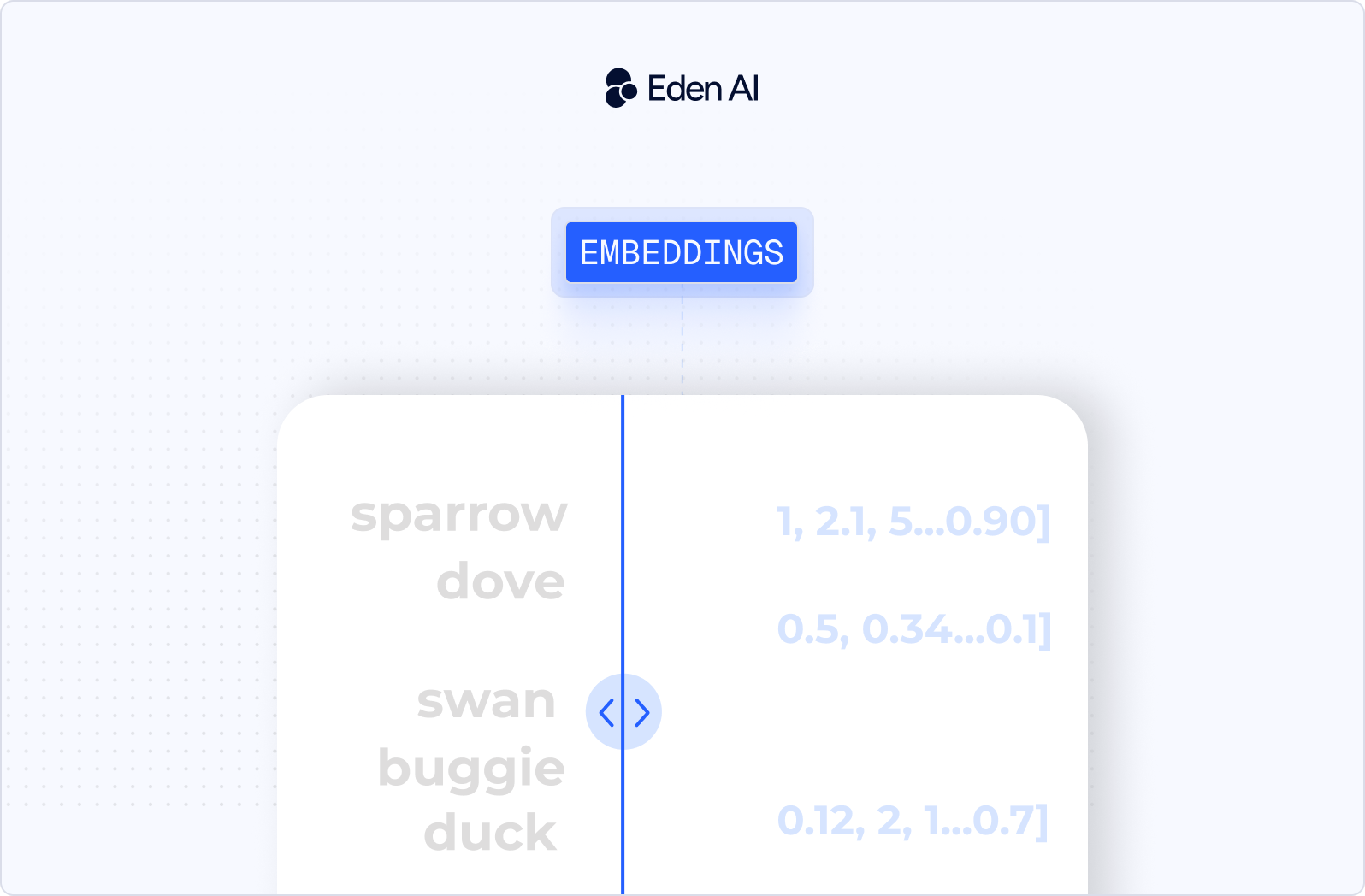
You can use embeddings through a hosted embedding API, which is easier to integrate and does not require GPUs, or through an open source model, which can be free to run but requires infrastructure, deployment, and monitoring.
How We Evaluated These Models
We evaluated each embedding model against criteria that matter in real developer workflows, from prototype testing to production RAG deployment.
Best Free Hosted Embedding APIs (No GPU Required)
The best free hosted embeddings APIs in 2026 are Google Gemini Embedding, Jina Embeddings v4, OpenAI text-embedding-3-small and Cohere embed-v4. Hosted embedding APIs are the fastest path to production when you do not want to manage GPUs, Docker images, inference servers, or model checkpoints.
Google Gemini Embedding - Best Overall Free Hosted Embedding API
Google Gemini Embedding is best for developers who want a generous free hosted embedding API with strong general-purpose performance and no infrastructure setup.
- Free Tier: 1,500 requests/day, 10M tokens/min, no credit card required
- Model name: gemini-embedding-001
- Dimensions: 3,072
- Context Window: Varies
- MTEB Score: 68.32
- Languages: Multilingual
The main advantage is the free quota, which is one of the most generous among hosted embedding providers. gemini-embedding-001 replaces text-embedding-004 and gives developers a strong default option for semantic search, retrieval, and classification workflows. Gemini Embedding 2 preview also adds multimodal support across text, images, and audio.
The catch is that Google may use free-tier inputs for model training, so teams handling sensitive or proprietary data should review the terms carefully before using the free tier in production.
import google.generativeai as genai

genai.configure(api_key="YOUR_API_KEY")

result = genai.embed_content(
    model="models/gemini-embedding-001",
    content="What is text embedding?",
    task_type="retrieval_document"
)

print(result["embedding"])
Jina Embeddings v4 - Best Free Embedding API for Long Documents & Multimodal
Jina Embeddings v4 is best for developers working with long documents, PDFs, images, or multimodal retrieval use cases.
- Free Tier: 1,000,000 tokens/month, no credit card
- Model name: jina-embeddings-v4
- Dimensions: 2,048, Matryoshka to 128
- Context Window: 32,768 tokens
- MTEB Score: Not specified
- Languages: 89
Jina Embeddings v4 embeds text, images, and PDFs into the same vector space, which makes it useful for applications that need to search across mixed content types. Its 32K context window helps reduce aggressive chunking for long-form content such as reports, documentation, and research papers. It also includes task-specific LoRA adapters for retrieval, classification, and clustering.
The catch is licensing: the open source version is CC-BY-NC-4.0, which means non-commercial only unless you use a commercial arrangement.
import requests

response = requests.post(
    "https://api.jina.ai/v1/embeddings",
    headers={"Authorization": "Bearer YOUR_JINA_KEY"},
    json={
        "model": "jina-embeddings-v4",
        "input": ["Your text here"]
    }
)

print(response.json()["data"][0]["embedding"])
OpenAI text-embedding-3-small - Best Embedding API for Teams Already on OpenAI
OpenAI text-embedding-3-small is best for developers already building with OpenAI APIs who want a stable hosted embedding model with simple integration.
- Free Tier: Free credits for new accounts, around $5, then $0.02/1M tokens
- Model name: text-embedding-3-small
- Dimensions: 1,536, Matryoshka to 256
- Context Window: 8,191 tokens
- MTEB Score: 62.3
- Languages: Multilingual
The main strength is ecosystem fit. If your application already uses OpenAI for chat, agents, evaluation, or tool calling, using the same SDK for embeddings keeps integration simple. Matryoshka Representation Learning lets you truncate vectors to fewer dimensions without retraining, which can reduce storage costs in vector databases.
The catch is that OpenAI does not offer an ongoing free tier for embeddings. Free credits expire, so this is better treated as a low-cost hosted option than a permanent free API.
from openai import OpenAI

client = OpenAI(api_key="YOUR_OPENAI_KEY")

response = client.embeddings.create(
    input="Your text here",
    model="text-embedding-3-small"
)

print(response.data[0].embedding)
Cohere embed-v4 - Best Embedding API for Very Long Documents
Cohere embed-v4 is best for teams embedding very long documents without splitting everything into small chunks first.
- Free Tier: Trial credits available after registration
- Model name: embed-v4.0
- Dimensions: 1,024
- Context Window: 128,000 tokens
- MTEB Score: Not specified
- Languages: 100+
The standout feature is the 128K context window, which is the longest among the hosted embedding options in this list. It can embed entire research papers, legal contracts, technical manuals, or large internal documents in a single call. Cohere also supports binary and int8 quantization, which can help reduce vector storage requirements.
The catch is that it is not truly free long term. After the trial, pricing starts at $0.10 per 1M tokens.
import cohere

co = cohere.Client("YOUR_COHERE_KEY")

response = co.embed(
    texts=["Your text here"],
    model="embed-v4.0",
    input_type="search_document"
)

print(response.embeddings[0])
Best Free Open Source Embedding Models (Self-Host)
The best open source embedding models in 2026 are Qwen3 Embedding (0.6B / 4B / 8B), BGE-M3 (BAAI), Nomic Embed Text v2, Jina Embeddings v4 (Self-Hosted), Snowflake Arctic Embed v2, mxbai-embed-large (Mixedbread), EmbeddingGemma-300M, and all-MiniLM-L6-v2.
Open source embedding models are the better fit when you need data privacy, no provider rate limits, or want to avoid API costs at scale. All models below are free to use, but licensing varies, so check commercial usage rights before deploying them in production.
Qwen3 Embedding (0.6B / 4B / 8B) - No 1 on MTEB Multilingual Leaderboard
Best for multilingual RAG and instruction-aware retrieval across large-scale datasets.
- License: Apache 2.0 ✅, commercial use allowed
- Parameters: 0.6B, 4B, 8B
- Dimensions: Up to 4,096, Matryoshka flexible
- Context: 32,768 tokens
- MTEB Score: 70.58 multilingual, 8B
- Languages: 100+
Qwen3 Embedding is technically interesting because it combines strong multilingual coverage with instruction-aware retrieval. You can prepend a task description to the input and often get a 1 to 5 percent accuracy improvement, which is useful for domain-specific retrieval, question answering, or classification-style search. The three model sizes also make deployment flexible: 0.6B for speed, 4B for balance, and 8B for maximum quality.
The limitation is hardware cost. The 8B model requires around 16GB VRAM, so edge or CPU deployments should use the 0.6B variant.
ollama run qwen3-embeddingBGE-M3 (BAAI) - Best for Production-Grade Multilingual Retrieval
Best for production RAG pipelines that need multilingual support and hybrid retrieval.
- License: MIT ✅
- Parameters: ~570M
- Dimensions: 1,024
- Context: 8,192 tokens
- MTEB Score: ~63.0
- Languages: 100+
BGE-M3 is widely used because it supports three retrieval modes in one model: dense retrieval, sparse retrieval, and multi-vector retrieval. That makes it useful for teams that want dense semantic search, BM25-style lexical matching, and ColBERT-style late interaction without maintaining separate models for each method. It is also practical for multilingual RAG, with support for more than 100 languages.
The trade-off is latency. BGE-M3 is slower than MiniLM-class models, so it is not the best choice for real-time search or very high-throughput APIs.
from sentence_transformers import SentenceTransformer; model = SentenceTransformer("BAAI/bge-m3")Nomic Embed Text v2 - Best Open Source for CPU Deployment
Best for teams without GPU access or applications running in resource-constrained environments.
- License: Apache 2.0 ✅
- Parameters: 475M total, 305M active MoE
- Dimensions: 768, Matryoshka to 64
- Context: 8,192 tokens
- MTEB Score: Strong
- Languages: ~100
Nomic Embed Text v2 is notable for using a Mixture-of-Experts architecture, which activates only 305M parameters per inference. This gives it a better quality-to-compute profile than a dense model of similar total size. It was trained on 1.6B contrastive pairs, making it a strong option for retrieval and semantic similarity when GPU resources are limited.
The limitation is that while the technical context limit is 8K tokens, the model performs best around a 512-token effective window. For long documents, chunking is still recommended.
ollama run nomic-embed-textJina Embeddings v4 (Self-Hosted) - Best for Multimodal Open Source
Best for developers building multimodal retrieval systems across text, images, and PDFs who want to self-host instead of using a hosted API.
- License: CC-BY-NC-4.0, non-commercial use only
- Parameters: 3.8B
- Dimensions: 2,048, Matryoshka to 128
- Context: 32,768 tokens
- MTEB Score: 71.7, Jina v5-small
- Languages: 89
Jina Embeddings v4 is technically interesting because it maps text, images, and PDFs into the same embedding space. This makes it useful for multimodal RAG, document search, visual search, and applications where users need to retrieve content across mixed formats. It also supports task-specific LoRA adapters for retrieval, classification, and clustering, which helps adapt the embedding behavior to different search and NLP workflows.
The limitation is licensing. The self-hosted open source version uses CC-BY-NC-4.0, so commercial production use requires a separate commercial arrangement.
from sentence_transformers import SentenceTransformer

model = SentenceTransformer("jinaai/jina-embeddings-v4")
Snowflake Arctic Embed v2 - Best for English Retrieval Tasks
Best for English-language RAG, semantic search, and retrieval-heavy applications.
- License: Apache 2.0 ✅
- Parameters: Not specified
- Dimensions: 1,024
- Context: 8,192 tokens
- MTEB Score: High
- Languages: English-focused
Snowflake Arctic Embed v2 is optimized specifically for retrieval tasks, which makes it a good fit for search, RAG, and knowledge base indexing. Its 1,024-dimensional embeddings offer a solid balance between retrieval quality and storage footprint. For English workloads, it provides strong MTEB performance with a practical quality-to-size ratio.
The limitation is multilingual coverage. It is not the right default if your corpus or users span many languages.
from sentence_transformers import SentenceTransformer; model = SentenceTransformer("Snowflake/snowflake-arctic-embed-l-v2.0")mxbai-embed-large (Mixedbread) - Easiest Embedding Model to Deploy
Best for teams that want a strong English baseline without instruction formatting or configuration overhead.
- License: Apache 2.0 ✅
- Parameters: Not specified
- Dimensions: 1,024
- Context: 512 tokens
- MTEB Score: ~64.5
- Languages: English-focused
mxbai-embed-large is designed to be simple to use. Unlike models that require instruction prefixes for best performance, it works well when you pass raw text directly. It is consistently strong on English MTEB tasks, which makes it a practical baseline for semantic search, document retrieval, and internal knowledge bases.
The limitation is context length. With a 512-token context window, it is not suitable for embedding long documents without chunking.
ollama run mxbai-embed-largeEmbeddingGemma-300M - Best Embedding Open Source Model for Edge / Mobile Deployment
Best for mobile apps, IoT devices, browser-based search, and on-device AI features.
- License: Open, Google
- Parameters: 300M
- Dimensions: 768, Matryoshka to 128
- Context: 2,048 tokens
- MTEB Score: Competitive
- Languages: 100+
EmbeddingGemma-300M is designed for constrained environments where local inference matters more than maximum benchmark score. With quantization, it can run in under 200MB RAM, making it practical for mobile and edge deployments. Its Matryoshka dimensions also let developers use 128-dimensional vectors when storage and latency are more important than peak retrieval accuracy.
The limitation is context length. A 2,048-token window is enough for short passages and app content, but not for full long-document embedding.
from transformers import AutoModel; model = AutoModel.from_pretrained("google/embedding-gemma-300m")
all-MiniLM-L6-v2 - Fastest Embedding Model
Best for real-time applications, high-throughput APIs, chatbot memory, and lightweight semantic matching.
- License: Apache 2.0 ✅
- Parameters: 22M
- Dimensions: 384
- Context: 256 tokens
- MTEB Score: Moderate
- Languages: English
all-MiniLM-L6-v2 remains useful because it is extremely fast, small, and broadly supported. At around 14.7ms per 1K tokens and roughly 1.2GB RAM usage, it is a strong fit for latency-sensitive applications and inexpensive batch processing. It is also supported across most vector databases, embedding libraries, and application frameworks.
The limitation is retrieval quality. Its 256-token context window and 384-dimensional embeddings usually put it 5 to 8 percent below BGE-class models on more complex MTEB retrieval tasks.
ollama run all-minilmWhich Free Embedding Model Is Right for Your Use Case?
The best embedding model in 2026 depends less on the leaderboard and more on your workload constraints. Start with your use case, then optimize for accuracy, context length, deployment model, latency, and language coverage.
Building a RAG Pipeline
Best pick: Qwen3-Embedding-8B, open source, because it has the #1 MTEB multilingual score, a 32K context window, and instruction-aware retrieval.
Runner-up: Google Gemini Embedding, if you want zero infrastructure and a free API.
For RAG, retrieval accuracy is everything. Qwen3’s instruction prefix, such as Represent this document for retrieval:, consistently improves recall@10 by 1 to 5 percent. Use it when you can self-host and want maximum retrieval quality across complex or multilingual corpora.
Multilingual Applications (Non-English)
Best pick: Qwen3 Embedding, because it supports 100+ languages and ranks #1 on MTEB multilingual.
Runner-up: BGE-M3, because it is the most battle-tested multilingual model in production.
If your app serves users in Arabic, Chinese, French, or any non-English language, skip English-optimized models entirely. Qwen3 and BGE-M3 were built for multilingual retrieval, not adapted afterward. Choose Qwen3 for best quality, and BGE-M3 when you want a proven production baseline.
Embedding Very Long Documents (Legal, Medical, Research)
Best pick: Cohere embed-v4, because its 128K context window can embed full documents in one call.
Runner-up: Jina Embeddings v4, because it offers a 32K context window and 1M free tokens/month.
Most models require chunking documents to fit their context limit. Cohere embed-v4’s 128K window can embed a 100-page document as a single vector, which is valuable for contracts, academic papers, financial reports, and technical manuals. Use Jina when you need a free hosted option with strong long-document support.
Edge / Mobile / On-Device Deployment
Best pick: EmbeddingGemma-300M, because it runs in under 200MB RAM and under 22ms on EdgeTPU.
Runner-up: all-MiniLM-L6-v2, because it has only 22M parameters and runs at roughly 14.7ms per 1K tokens.
EmbeddingGemma-300M is the 2025 default for on-device use. Its Matryoshka dimensions let you compress vectors to 128 dimensions without retraining, reducing storage and latency on mobile. Use MiniLM when raw speed and broad ecosystem support matter more than retrieval accuracy.
Multimodal Search (Text + Images + PDFs)
Best pick: Jina Embeddings v4, because it embeds text, images, and PDFs in one shared vector space.
Runner-up: Google Gemini Embedding 2 preview, because it supports multimodal inputs across text, image, audio, and video.
If your pipeline ingests a mix of PDFs, screenshots, and text, use a multimodal embedding model from the start. Retrofitting multimodal retrieval later usually means re-indexing your data and changing your search pipeline. Jina v4’s 1M free tokens/month makes it accessible for prototypes and early production tests.
Fast Prototyping with No Setup
Best pick: Google Gemini Embedding, because it gives 1,500 requests/day free with no credit card.
Runner-up: Jina Embeddings v4 API, because it gives 1M tokens/month free.
For a weekend project or proof-of-concept, both options give you a production-quality embedding model in under 5 minutes. Google wins on quota and setup simplicity. Jina wins on context length and multimodal document support.
Some teams should not standardize on a single embedding model. A production stack might use Qwen3 for multilingual RAG, MiniLM for real-time autocomplete, and Jina for multimodal document search, which is exactly where a unified AI platform like Eden AI becomes useful.
Access 10+ Embedding APIs Through One Unified Endpoint
Integrating multiple embedding providers adds overhead fast. Each provider comes with its own API keys, SDK format, response schema, error handling, and rate limit logic. Every time you want to test a new embedding model, you often need to rewrite part of your integration. For teams running A/B tests across Cohere, OpenAI, and Jina, that means three separate integrations to maintain.
Eden AI provides a single REST API endpoint that routes embedding requests to 10+ providers, including Cohere, OpenAI, Google, Jina, and others. You keep one integration layer while still comparing models across different providers. Switching providers is a one-word change in the providers field.
- One API key, one SDK, one error-handling layer for all providers.
- Switch models in one line of code with no re-architecture needed.
- Built-in fallback lets you route to another provider if one is down.
import requests

response = requests.post(
    "https://api.edenai.run/v2/text/embeddings",
    headers={"Authorization": "Bearer YOUR_EDENAI_KEY"},
    json={
        "providers": "openai",
        "texts": ["What is text embedding?"],
        "response_as_dict": True
    }
)

print(response.json())

.jpg)
.png)