Summarize this article with:
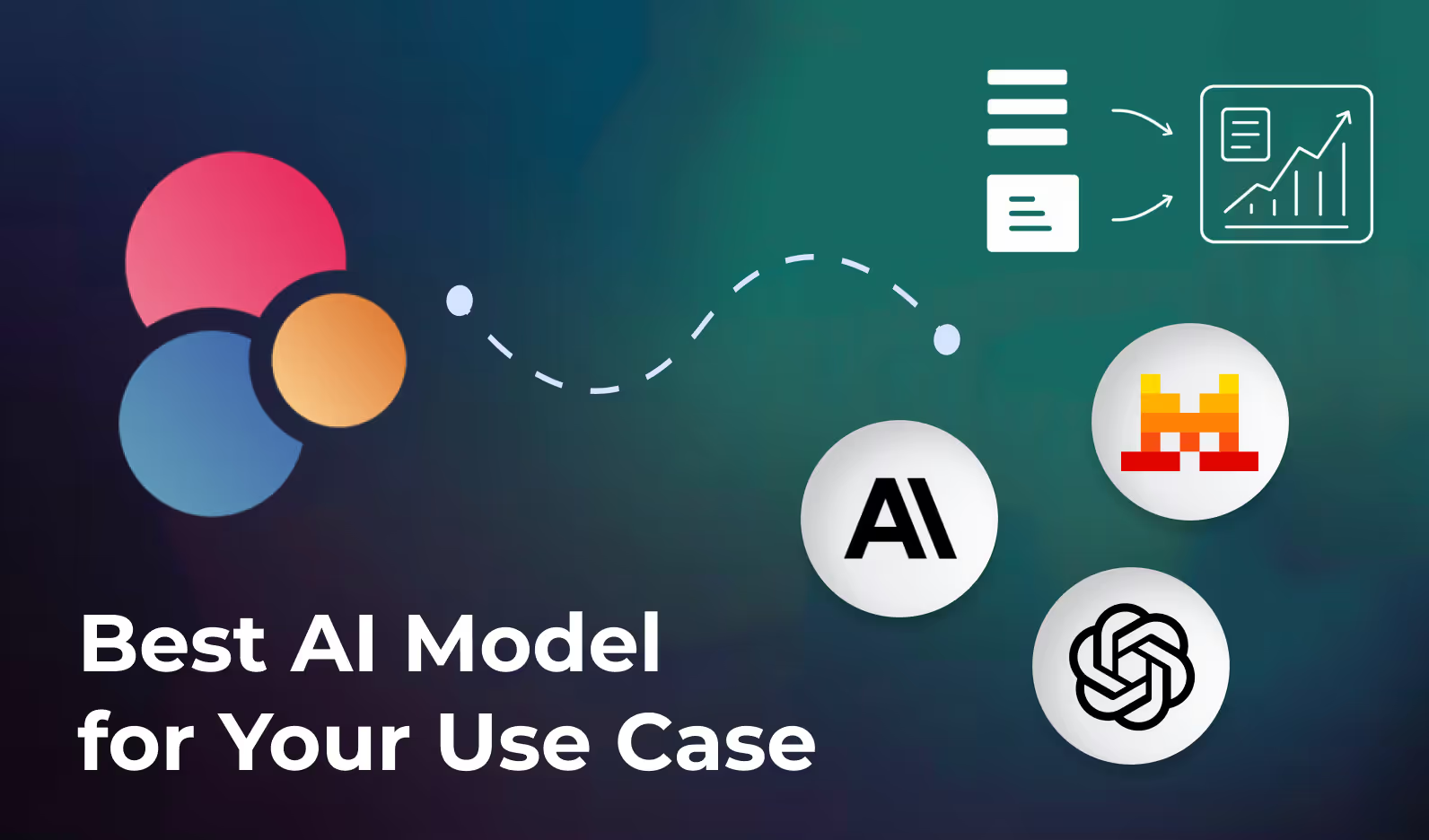
OpenAI, Anthropic, Mistral: Which AI Model Performs Best for Your Use Case?
With new LLMs emerging every few months, developers face a key decision: which provider’s model should power their product? OpenAI remains a leading choice for reliability and ecosystem support, Anthropic is known for safety and contextual reasoning, and Mistral stands out for open-source flexibility and cost-efficiency.
Yet, there’s no universal “best” model, performance depends on your application’s goals. The model comparison process, evaluating cost, latency, and quality, is the most reliable way to find the right balance.
1. OpenAI: versatility and ecosystem power
OpenAI’s models like GPT-4 and GPT-4o are industry benchmarks for accuracy, fluency, and broad task coverage. They perform particularly well in:
- Conversational agents and chatbots
- Creative text generation
- Multi-modal tasks (image + text)
Strengths:
- Excellent reasoning and creativity
- Robust API and ecosystem (Assistants, Fine-tuning, Embeddings)
- Strong multilingual capabilities
Limitations:
- Cost can be high for large-scale usage
- Closed-source and dependent on OpenAI’s pricing model
For most general-purpose applications, OpenAI offers high quality and minimal integration friction,but flexibility can be limited.
2. Anthropic: safety, context, and alignment
Anthropic’s Claude models are designed for safety, long-context reasoning, and aligned responses. They excel in professional and enterprise scenarios where factual accuracy and coherence are key.
Best suited for:
- Knowledge management or documentation tools
- Business writing and summarisation
- Research assistants and legal text analysis
Strengths:
- Long context windows (up to 200k tokens)
- Polished, safe, and coherent outputs
- Strong reasoning and comprehension
Limitations:
- Fewer fine-tuning options
- Slightly slower response times than GPT-4 in some tasks
As noted in benchmarking multi-LLM setups, Anthropic often performs best for context-heavy, instruction-following workloads.
3. Mistral: open models and efficiency
Mistral takes a different approach, offering open-weight models (like Mixtral 8×7B) and an API that prioritises speed and transparency. Their models provide strong reasoning capabilities while remaining lightweight and cost-efficient.
Best suited for:
- On-premise or privacy-sensitive projects
- Low-latency or edge deployments
- Custom fine-tuning and experimentation
Strengths:
- Open-weight availability (ideal for self-hosting)
- Competitive reasoning at lower cost
- Great performance on structured tasks
Limitations:
- Smaller ecosystem than OpenAI or Anthropic
- Requires more engineering for integration and fine-tuning
The multi-API integration approach helps overcome this by connecting Mistral’s models through a single API layer alongside commercial ones.
4. Choosing the right model for your use case
Each provider has a different value proposition, rather than picking one, you can combine them strategically. For example:
- Use Mistral for cost-sensitive, high-frequency tasks
- Use OpenAI for complex reasoning or creative outputs
- Use Anthropic for long-context or high-accuracy requirements
A multi-provider setup with routing and fallback mechanisms ensures optimal performance and reliability. As described in the load balancing guide, intelligent routing selects the best provider per request based on metrics like latency, cost, and success rate.
How Eden AI helps you avoid these mistakes
Eden AI simplifies cross-provider experimentation through its unified API, allowing you to test, compare, and route requests between OpenAI, Anthropic, Mistral, and others; without rewriting your code.
Key advanced features include:
- AI Model Comparison – benchmark model quality, latency, and cost across providers.
- Cost Monitoring – visualise and control your API expenses per provider or model.
- API Monitoring – track performance, response times, and errors across all integrations.
- Caching – improve speed and reduce redundant calls by storing frequent responses.
- Multi-API Key Management – manage multiple API keys securely and route traffic intelligently.
These features allow you to integrate multiple AI APIs with confidence, avoid redundancy, and maintain full control of your architecture.
Conclusion
OpenAI, Anthropic, and Mistral each bring unique advantages to the LLM ecosystem. The best model depends on your use case, whether it’s creative generation, structured reasoning, or scalable experimentation.
Through Eden AI’s unified platform, developers can stop choosing between providers and start leveraging them all at once. By testing, comparing, and routing requests intelligently, you ensure that every task runs on the most efficient model available, both in performance and cost.

.jpg)
.png)