Summarize this article with:
- An Open-Source LLM Hosting Provider is a platform or service that deploys, manages, and serves open-source large language models on behalf of users , allowing developers to access these models via...
- Developers should host open-source LLMs if you want to control, customization, and cost efficiency at scale .
- AWS Bedrock is the best open-source LLM hosting provider for enterprise governance.
- Key criteria include task-specific accuracy, pricing per request, supported languages, API latency, and ease of integration.
- Eden AI provides a unified REST API connecting to all major Open-Source LLM Hosting Providers providers, allowing integration with a single API key and a standardized JSON response format...
What is Open-Source LLM Hosting?
Open-source LLM hosting is the process of self-hosting or using infrastructure to run open-weight language models (e.g., LLaMA, Mistral) on your own servers, cloud instances, or specialized platforms, giving you full control over inference, data, and customization.
An Open-Source LLM Hosting Provider is a platform or service that deploys, manages, and serves open-source large language models on behalf of users, allowing developers to access these models via APIs without handling the underlying infrastructure.
When Should You Host Open-Source LLMs?
Developers should host open-source LLMs if you want to control, customization, and cost efficiency at scale. Firstly, hosting your own models means no data leaves your infrastructure, improving data privacy.
Secondly, with self-hosting, you shift to fixed or semi-fixed GPU costs, it becomes cheaper only at scale and with stable workloads. And finally, with open-source models, developers can fine-tune on your proprietary data, adjust system behavior at a deeper level and align outputs with your domain.
Teams should not change to open-source LLMs hosting if your teams' objectives are speed, simplicity, and zero infrastructure overhead. In this case, you should consider using the best LLMs in 2026.
In these cases, using an API gateway like Eden AI can be a better alternative, allowing teams to access multiple LLM and expert models without managing infrastructure, while still keeping flexibility and control over model selection.
Top Open-Source LLM Hosting Providers (Short Comparison)
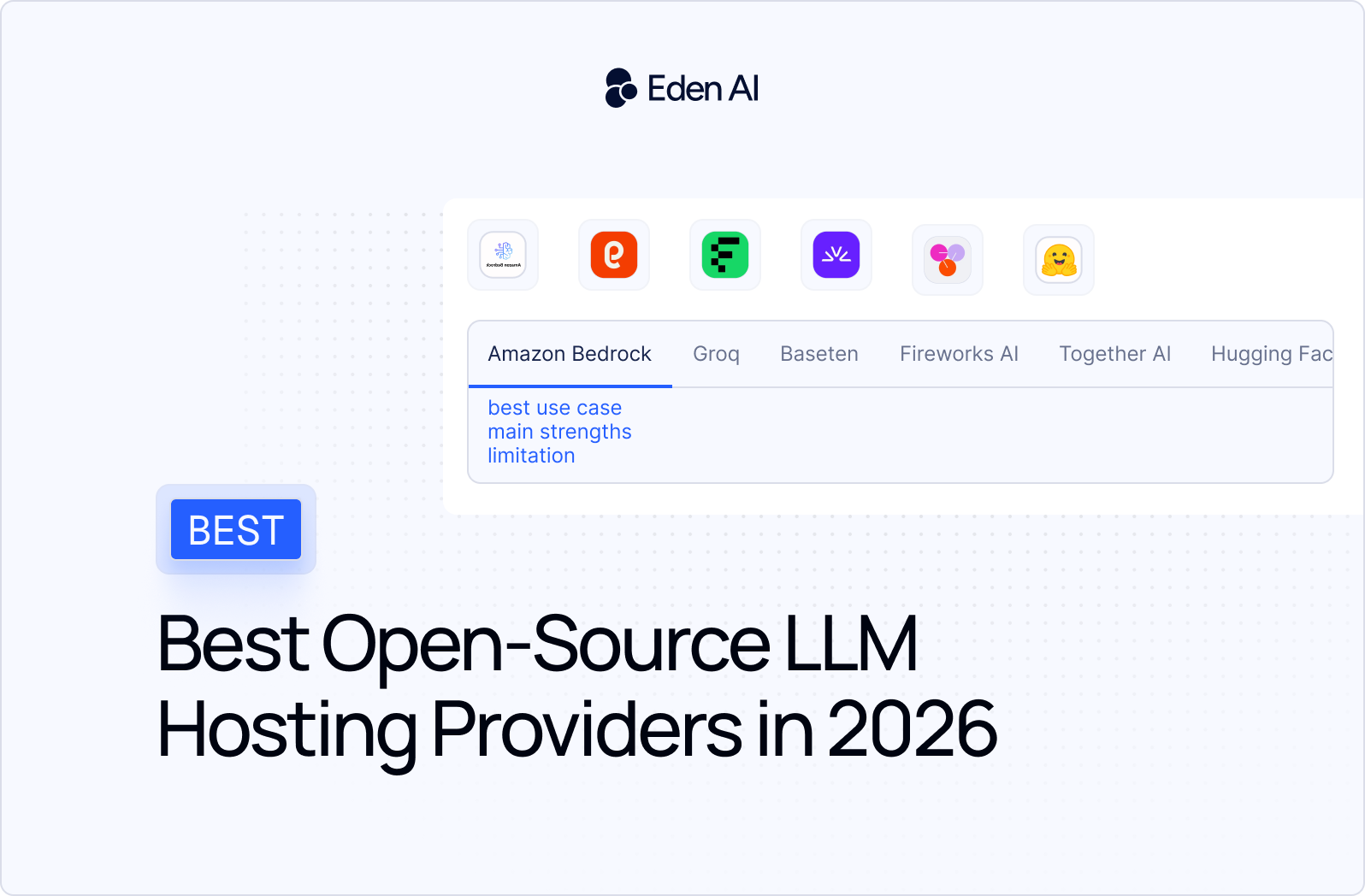
The best open-source LLM hosting providers in 2026 are Together AI, Hugging Face Inference Endpoints, Fireworks AI, Baseten, Groq and AWS Bedrock. We present short comparisons about their best use case, main strengths and limitations so you can have a quick look.
Top Open-Source LLM Hosting Providers in 2026 (Updated)
We give you in-depth analysis of 6 best open-source LLM hosting providers in 2026 according to what they do best, their pros and cons, and pricing.
Together AI
Together AI is the best open-source LLM hosting provider for startups. Available on Eden AI, the Together AI API covers an all-rounder open-source LLM hosting platform which spans serverless inference, batch inference, dedicated inference, fine-tuning, and GPU clusters, which means you can start with API calls and later move to more controlled deployment modes without changing providers.
Pros:
- Support a large catalog of modern models
- Have a clear path from experimentation to production
- Fast inference
Cons:
- Not as deeply tied into enterprise controls and governance
- Not have the same "deploy any Hub model with minimal thought"
Best For: Team building a product that may move through three phases: prototype fast, fine-tune or customize later, then scale to dedicated infrastructure.
Pricing: per-token for serverless inference, separate pricing for fine-tuning, and infrastructure-style pricing for GPU capacity
Hugging Face Inference Endpoints
Hugging Face Inference Endpoints is the best open-source hosting provider at model ecosystem access. Its dedicated Inference Endpoints are autoscaling and billed by time, not tokens, and they sit naturally inside the broader Hugging Face workflow.
Pros:
- Flexibility: the Hugging Face Hub remains the center of gravity for open models, and Inference Endpoints let you operationalize that with much less effort than self-hosting
- Integration and ease of spinning up endpoints
Cons: Less of an "all-in-one inference platform strategy"
Best For: R&D-heavy teams and startups testing many open models, want to stay close to the open-model ecosystem, and value deployment simplicity over squeezing every last millisecond from inference.
Pricing: Time-based, endpoints start at $0.033/hour on one page and "starting as low as $0.06/hour" on the endpoint marketing page.
Fireworks AI
Fireworks is the most clearly performance-oriented of the open-model hosting specialists. It is built around fast inference, on-demand deployments, and efficient serving of popular open models, and its messaging is much more about throughput and latency than about ecosystem breadth.
Pros: strong production performance first
Cons: Not the easiest first stop for a team with weak infra chops.
Best For: Teams building real-time assistant, AI search layer, coding product, or production API where latency and throughput are core product metrics. Or teams already know roughly which models it wants and cares more about inference engineering than browsing the model universe.
Pricing: Pay-as-you-go pricing across products: per token for serverless inference, per GPU usage time for on-demand deployments, and per token of training data for fine-tuning.
Baseten
Baseten is the best open-source hosting provider when inference is already a serious production systems problem. Its strengths are dedicated deployments, single-tenant options, observability, and compliance posture, rather than just "easy hosted model access."
Pros:
- Security and production maturity: SOC 2 Type II and HIPAA compliance
- Capable of being region-locked
Cons: Not the most lightweight choice for a small team just testing models
Best For: Team serving a customer-facing AI product in regulated or high-availability environments, or when observability, dedicated infrastructure, and infra controls matter nearly as much as model quality.
Pricing: both Model APIs priced per 1M tokens and infrastructure-style offerings like dedicated deployments.
Groq
Groq is the best open-source LLM hosting provider on raw speed perception. Its whole product is built around low-latency inference on Groq hardware, and even its docs surface tokens-per-second directly alongside pricing and limits.
Pros:
- Fast enough for users to feel the difference
- Good for "huge input/output token work" and simple high-volume tasks
Cons: Flexibility: not compete on widest open-model hosting ecosystem
Best For: Team needing real-time UX: voice assistants, interactive copilots, ultra-fast chat, streaming generations, or high-volume transformation tasks where latency is part of the product itself.
Pricing: Token-priced, pricing examples include Qwen3 32B at $0.29 per 1M input tokens and $0.59 per 1M output tokens.
Amazon Bedrock
Amazon Bedrock is the best open-source LLM hosting provider for enterprise governance in 2026. It is not as a pure open-source host, but as an AWS-native managed model platform. Its key advantage is not "best open-model serving UX"; it is enterprise integration, governance, and breadth inside AWS.
Pros:
- IAM integration
- Regional controls
- Managed access to multiple providers
Cons: Feels like an AWS service first and a delightfully simple developer product second.
Best For: Large companies already committed to AWS-native architecture, has security and compliance requirements, and wants one managed platform for multiple model providers.
Pricing: Supports on-demand token pricing, provisioned throughput, fine-tuning / customization for some models, and Custom Model Import pricing by model unit.

.jpg)